Artificial Intelligence Radio Access Network (AI-RAN) with Digital Twin
Executive Summary
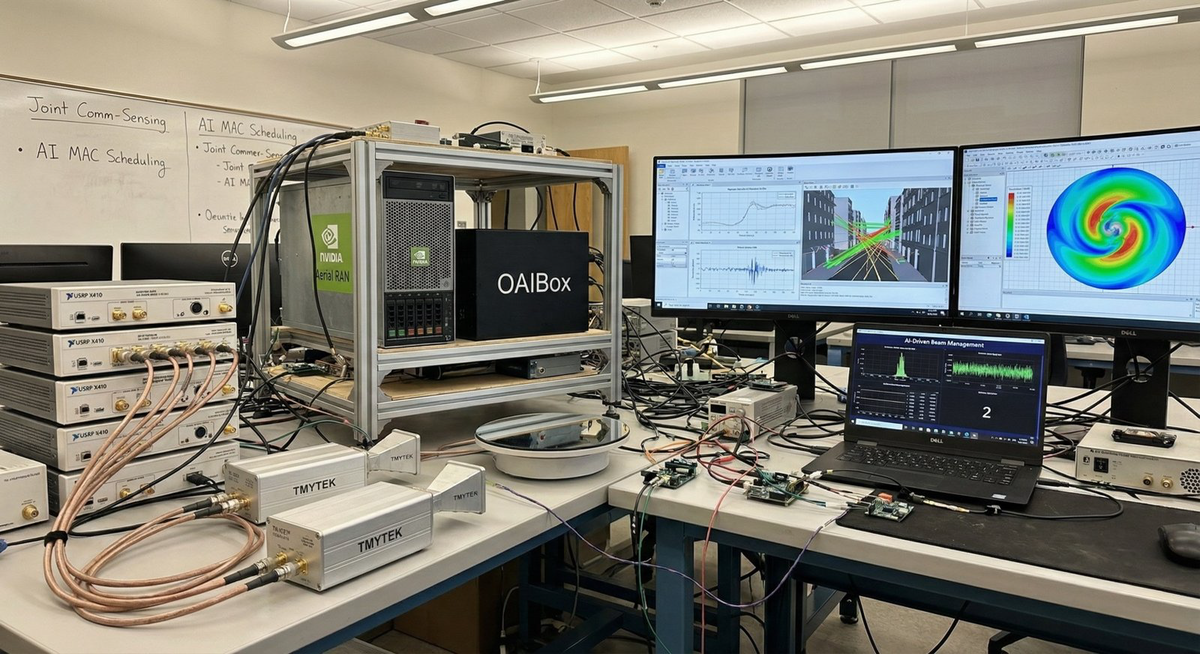
This lab-scale mmWave AI-Based RAN testbed integrates OAIBox, NVIDIA Aerial RAN, NI USRP X410, TMYTEK mmWave beamformers, and a high-fidelity Digital Twin pipeline using Remcom Wireless InSite and ANSYS HFSS SBR+ to create a flexible, programmable, and AI-native 5G/6G research environment. It enables real-time prototyping of mmWave physical layers, AI-driven beam management, hybrid beamforming, AI-enhanced MAC scheduling, and joint communication–sensing (ISAC) experiments. The platform supports end-to-end 5G NR PHY/MAC stacks, GPU-accelerated baseband processing, and mmWave RF front-ends for high-bandwidth OTA testing, while the Digital Twin provides physics-accurate ray-tracing, EM-based antenna modeling, and virtual–to–real co-simulation for channel prediction, beam optimization, and AI dataset generation.
Core Components
OAIBox – OpenAirInterface RAN Framework
The testbed uses OAIBox as a compact and modular implementation of the full OAI RAN stack. It provides:
- Support for 5G SA/NSA gNB and UE
- Flexible PHY–MAC integration
- Customizable scheduling, HARQ, and protocol features
- Real-time experimentation with RAN procedures and RRC signaling
OAIBox acts as the protocol and control anchor of the testbed.
NVIDIA Aerial RAN (cuPHY + cuMAC)
The NVIDIA Aerial platform provides GPU-accelerated baseband processing and AI-native PHY/MAC capabilities:
- cuPHY for NR physical-layer DSP on GPUs
- cuMAC for dynamic MAC scheduling on GPU
- TensorRT for real-time neural inference
- Support for multi-cell, multi-user, and high-throughput pipelines
Aerial enables experiments in:
- AI-driven beam selection and prediction
- Neural channel estimation
- Predictive link adaptation and blockage detection
NI USRP X410 – Wideband Software-Defined Radio
The USRP X410 serves as the flexible transceiver frontend with:
- Up to 400 MHz instantaneous bandwidth
- Four synchronized TX/RX channels
- 10/1588 PTP synchronization
- Digital IF for integration with NVIDIA Aerial
It supports:
- mmWave IF/baseband experimentation
- Real-time CSI acquisition
- Multi-subarray MIMO and wideband waveform prototyping
TMYTEK mmWave Beamformers (BBox, UD-Box, Beamform Modules)
TMYTEK hardware provides programmable mmWave RF front-ends:
- UD-Box for 24–32 GHz up/down-conversion
- BBox One / BBox Lite beamforming arrays
- API-driven phase/gain control
- Rapid beam steering and codebook-based operation
These modules enable:
- Hybrid or analog beamforming
- Electronic steering up to ±60°
- Multi-beam and multi-focus mmWave experimentation
Digital Twin
A full Digital Twin framework integrates high-fidelity electromagnetic simulation with the physical testbed. This enables reproducible channel modeling, data augmentation, and virtual-to-real RAN optimization.
Remcom Wireless InSite – Ray Tracing Propagation
Wireless InSite provides a large-scale propagation environment supporting:
- GPU-accelerated 3D ray tracing
- Detailed mmWave diffraction, reflection, and scattering
- Urban, indoor, and open-field scenario modeling
- Material-dependent loss and blockage effects
- Beam-level channel prediction
ANSYS HFSS SBR+ – Full-Wave EM Modeling
HFSS SBR+ enables full-wave modeling of:
- Antenna arrays, including TMYTEK beamformers
- Reflectarrays, metasurfaces, and RIS
- Realistic gain patterns for hybrid beamforming
- Complex EM interactions under mmWave frequencies
Capabilities
AI-Enhanced RAN Intelligence
- Neural beam prediction and tracking
- AI-based MAC scheduling
- CSI-driven link adaptation models
- Blockage prediction and proactive beam switching
mmWave PHY/MAC Research
- Hybrid and digital beamforming
- Channel sounding and dataset generation
- Evaluation of mobility, rotation, and blockage
- 5G NR waveform prototyping
Flexible RAN Architecture
- O-RAN 7.2 split between OAIBox and Aerial
- Multi-RU and multi-sector emulation
- Edge-cloud cooperative intelligence
ISAC (Integrated Sensing and Communication) Extensions
- Joint radar–communication waveform experiments
- 2D/3D angle estimation
- Passive sensing with GPU-accelerated FFT pipelines
Digital Twin–Driven Insights
- Predictive channel statistics and blockage maps
- Virtual scenario pre-testing
- Dataset augmentation for AI training
- Virtual beam codebook optimization